· ReadyStack
Worked example
Real numbers from this tool, line by line.
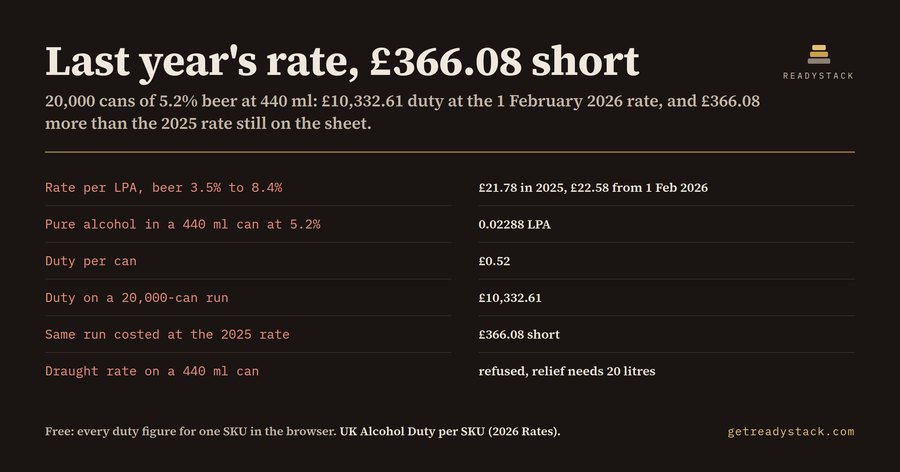
A 20,000-can run of 5.2% ABV beer in 440 ml cans carries £10,332.61 of UK alcohol duty at the rates that took effect on 1 February 2026. Costed on the rate a British craft brewer most likely still has on the price sheet - the 1 February 2025 figure of £21.78 per litre of pure alcohol - the same run comes out at £9,966.53. The gap is £366.08, on one run, of one SKU.
That is the whole problem in one line. UK alcohol duty is charged per litre of pure alcohol (LPA), not per litre of liquid, and the rate depends on which ABV band the product falls in and which category it is. On 1 February 2026 every rate was uprated by 3.66% in line with RPI. Nothing about the product changed. Only the number in the table did.
Here is what that looks like for the beer above. A 440 ml can at 5.2% ABV contains 0.44 x 0.052 = 0.02288 litres of pure alcohol. Beer in the 3.5% to 8.4% band pays £22.58 per LPA from 1 February 2026, so the duty is £0.52 a can. Twenty thousand cans: £10,332.61. At the 2025 rate of £21.78 it would have been £0.4984 a can. Half a penny a can is invisible. Across a run it is £366.08, and across a year of runs it stops being invisible.
The second thing that goes wrong is draught relief. Products under 8.5% ABV that go out in a container of at least 20 litres, designed to connect to a dispense system, pay a reduced rate: £19.45 per LPA instead of £22.58, and £8.95 instead of £10.39 for still cider. Forty 30-litre kegs of 4.2% beer is 1.26 LPA a keg, £24.51 a keg, £980.28 for the run, with £157.75 of that saved by the relief. The trap is that the relief is a property of the container, not of the drink. Ask a chatbot for "the draught rate for my 4.2% beer" and it will hand you £19.45 without asking how big the container is. Apply that to a 440 ml can and you have understated the duty on every can you sell.
The third is the band edge. Beer, still cider and wine, spirits and other fermented products all pay different rates in the 3.5% to 8.4% band - £22.58, £10.39 and £26.61 - and then converge at £30.62 once the product reaches 8.5% ABV. An importer costing 6,000 bottles of 12% wine at 750 ml is in the 8.5% to 22% band at £30.62 per LPA: 0.09 LPA a bottle, £2.76 a bottle, £16,534.80 for the shipment. Use the 3.5% to 8.4% wine rate by habit and the arithmetic is confidently, quietly wrong.
None of this is hard. It is four multiplications. What makes it expensive is that the inputs move: the rate table was uprated on 1 February in each of the last two years, and a costing spreadsheet built in 2024 does not know that. Neither does a language model trained before the change - ask one today and it will answer with the 2025 table, because that is what it read.
So this is a browser extension and a free web page that share the same calculator. Pick the category, type the ABV, the container size and how many containers are in the run, tick draught if it goes out in a keg, and it returns the band, the 2026 rate, the pure alcohol per container, the duty per container, the duty on the run, the gap against whatever rate your sheet is using, and the amount draught relief saved - or a refusal, with the reason, when the container is too small to qualify. Every one of those numbers is free, with no key and no limit.
The $60 licence key does a different job: it exports the SKUs you have priced as a CSV, so the numbers land in your duty return, and it sets an alarm before the next uprating date. Brewery software that files the duty return for you starts at £29.99 a month.
Rates: HMRC, Alcohol Duty rates, gov.uk/guidance/alcohol-duty-rates.
15 seconds — what it actually does
Full walk-through
Questions people ask
What does this actually work out?
It takes one product - category, strength, container size and run size - and returns the UK duty. A 20,000-can run of 5.2% beer in 440 ml cans is 0.02288 LPA a can at £22.58 per litre of pure alcohol, so £0.52 a can and £10,332.61 for the run: £366.08 more than the 1 February 2025 rate of £21.78.
Who is it for?
UK craft brewers, cidermakers, small distillers and drinks importers who set their own prices and file their own alcohol duty return. If somebody in your business types a duty rate into a costing sheet or a customer quote, this is the check that rate should pass first.
Why not just ask a chatbot or use a free calculator?
Duty rates were uprated on 1 February 2026 and models trained earlier answer with the 1 February 2025 table, which is 3.66% low. Most free calculators also hand you the draught rate without testing the 20-litre container rule, so a 440 ml can gets a keg rate.
What is free and what needs the key?
Every number is free and unlimited: band, rate, pure alcohol per container, duty per container, duty on the run, the gap against your sheet, and the draught test. The $60 key is a different job - exporting those rows as CSV and setting an alarm before the next uprating.
What would this cost otherwise?
Brewery management software that calculates and files the UK duty return starts at £29.99 a month, roughly £360 a year, and you buy the whole production system to get the duty numbers. This is a one-off $60 key, and the calculation itself stays free forever.
Ask about this tool
One question, answered by the person who built it. Your email only if you want the answer sent.